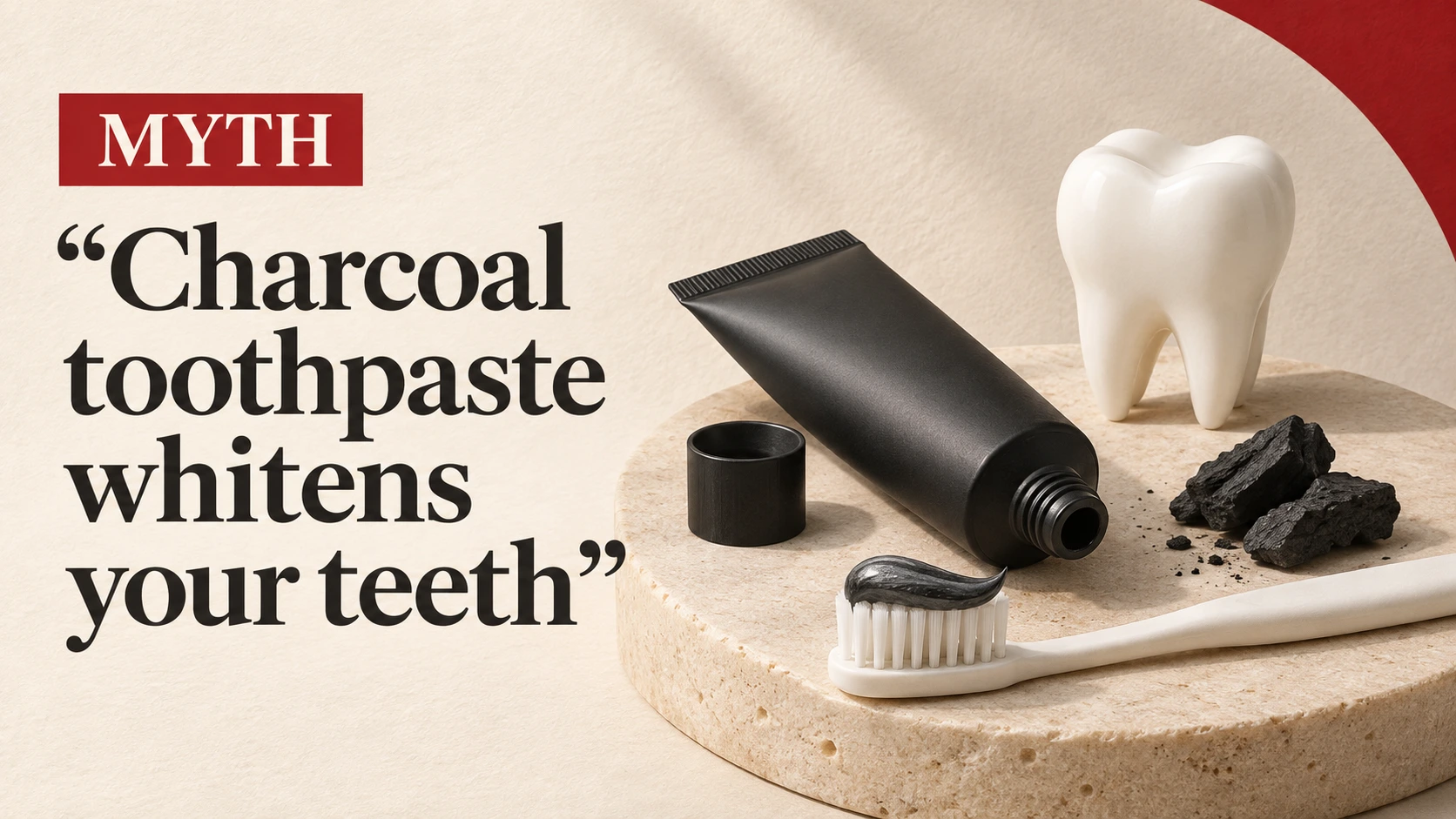
A black toothpaste… that gives you a white smile?
I know the idea is simple and appealing, and the before-and-after videos are convincing.
But let’s look at what actually happens.
Does it whiten?
Charcoal is abrasive.
So it can remove surface stains, like coffee and tea stains, and make teeth look cleaner.
But that’s polishing, not whitening.
The real colour of a tooth comes from inside it, and charcoal can’t reach that.
Is it safe?
This is where the problem is:
- It wears down enamel: with daily use, it can thin the enamel. As it thins, the layer underneath shows through more, and that layer is yellow. So teeth can end up more yellow, not whiter.
- Most have no fluoride: you lose your most important protection against decay.
- It gets stuck: charcoal particles can get trapped along the gum line or around fillings and leave a grey tint.
Research reviews so far haven’t found enough evidence that it whitens teeth, or that it’s safe in the long term.
What to use instead
- For surface stains: a clean at the dentist, and a regular fluoride toothpaste.
- For real whitening: whitening supervised by a dentist, either with custom trays or in the clinic with a light or laser, which changes the colour from inside the tooth safely.
The short version
Charcoal polishes, it doesn’t whiten.
And in the long run, it can do the opposite.